

Record growth, open banking as a new lever – and a valuation that still leaves room for improvement
Within just two years, net digital AG has developed from a barely noticed German micro cap to a profitable payment and telecommunications service provider with strong growth. The preliminary half-year figures for 2026 indicate that the momentum is even increasing. At the same time, the company is building its own open banking platform with “Net Money”. With a market capitalization of only around 40 million euros, it is precisely this combination of profitable existing business and new fintech optionality that could be interesting for investors.
From turnaround story to growth story
In the case of small listed companies, there are always situations in which the operational reality changes much faster than the perception on the capital market. net digital AG could be such a case.
As recently as 2024, the Düsseldorf-based group generated sales of only 11.0 million euros. EBITDA was practically at zero. One year later, the income statement already had 37.8 million euros in sales, 4.19 million euros in EBITDA and 2.88 million euros in net income. Revenue has thus more than tripled within one year. Even more importantly, growth turned into real earnings growth for the first time.
And in 2026, this development does not seem to stop.
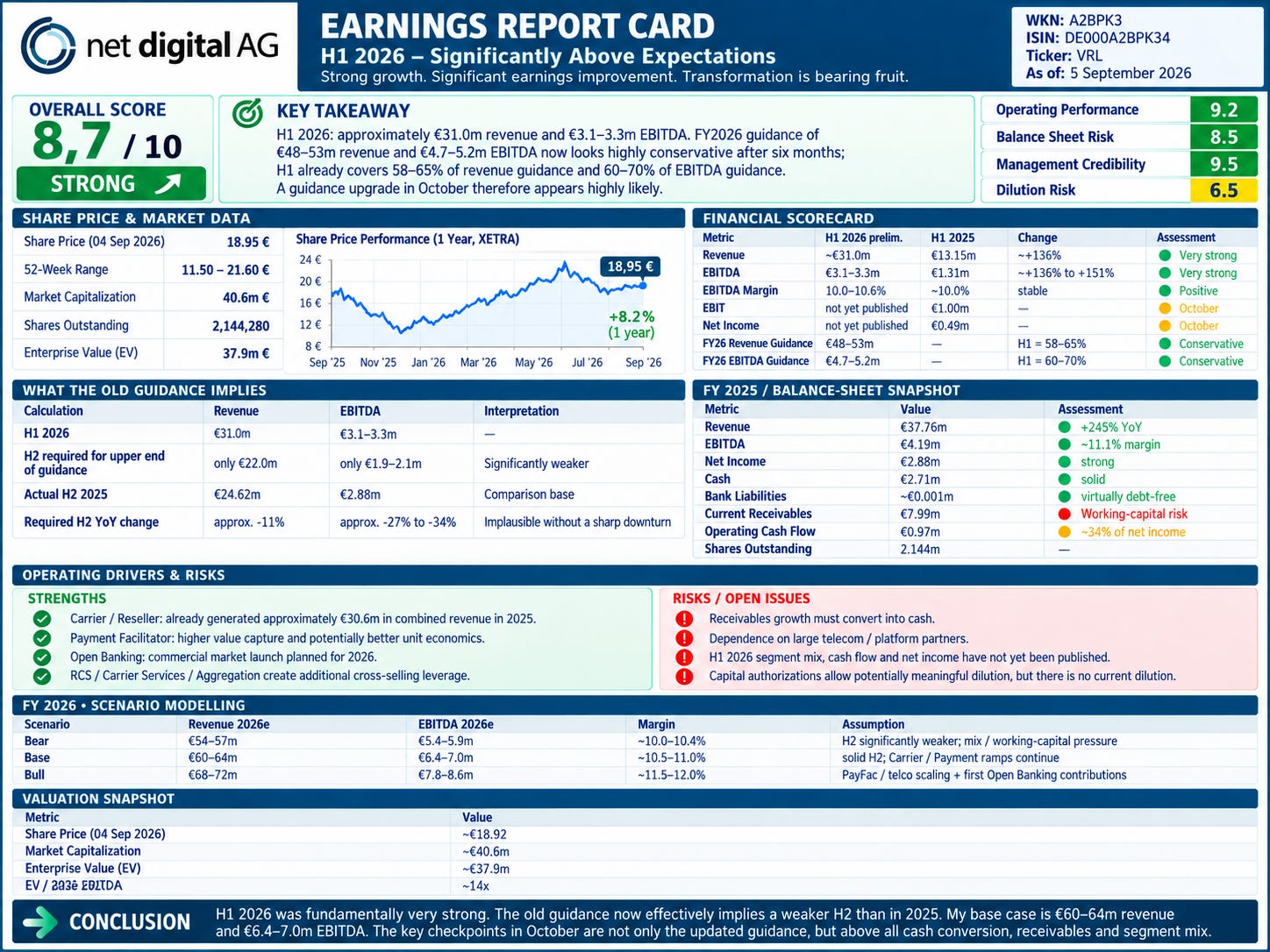
On August 25, net digital reported preliminary figures for the first half of 2026. Revenue rose to around EUR 31 million, compared to around EUR 13 million in the same period last year. EBITDA is expected to be between EUR 3.1 million and EUR 3.3 million, after around EUR 1.3 million in the first half of 2025. The full half-year report is not expected to be published until October.
These are remarkable figures for a company whose market capitalization is currently only around 40 million euros. But the more exciting question is no longer whether net digital can grow profitably. The company proved this in 2025. Rather, the decisive factor is: How big can net digital become if open banking is added to the existing payment, carrier and reseller business in the coming years? This is exactly where the real investment thesis begins.
What does net digital actually do?
Net digital is not a classic software company or a pure payment service provider. The business model lies at the interface between telecommunications, payment, billing, digital platforms and, increasingly, financial technology.
The Group holds shareholdings in mobile business engine GmbH, ecardon payments GmbH, net mobile minick GmbH, Cubic24 communications GmbH and the AI subsidiary irisnet GmbH, among others. The main areas of revenue are payment services, digital enabling and communication and messaging services.
For 2025, more than 80 percent of revenues will now come from the carrier and reseller environment. This explains a significant part of the growth spurt. Cooperation with telecommunications companies plays an important role in this. As early as 2023, the subsidiary mobile business engine concluded a far-reaching framework agreement with 1&1 for direct carrier billing. MBE developed its own carrier-grade platform for this purpose. 1&1 wanted to enable its then around twelve million mobile customers to pay for digital products and services via their mobile phone bill, among other things.
Net digital is thus at an interesting point in the value chain: The company has the technical infrastructure to process large transaction volumes between telecommunications companies, merchants and end customers. And especially with such platform models, additional volumes can be very attractive once the infrastructure has been set up.
The half-year figures for 2026 change the starting position
In my view, the key data for H1 2026 presented in August are the most important point of the current investment thesis. The market was previously familiar with the annual forecast from March:
Sales 2026: 48 to 53 million euros
EBITDA 2026: EUR 4.7 million to EUR 5.2 million.
Now, after six months, around EUR 31 million in sales and EUR 3.1 to 3.3 million in EBITDA have already been achieved. This means that after six months, Net digital has already achieved around 58 to 65 percent of the previous annual revenue forecast and around 60 to 70 percent of the EBITDA forecast.
A simple extrapolation of the first half of the year would of course be too aggressive. Sales and earnings do not have to be evenly distributed over both half-years. Nevertheless, it is hard to overlook the fact that the existing forecast looks increasingly conservative. This opens up a short-term catalyst: an increase in the forecast in connection with the half-year report in October seems at least plausible.
The quality of growth is more important than sales alone
When analysing net digital, however, one should not make the mistake of only looking at the sales development. The business includes considerable ongoing or transaction-dependent expenses. In 2025, for example, 37.8 million euros in sales were offset by material expenses or services purchased of 28.2 million euros.
With such business models, the development of EBITDA, EBIT and cash flow is therefore more meaningful than pure revenue growth. And this is exactly where the development is positive.
In 2025, EBITDA rose to EUR 4.19 million, EBIT reached EUR 3.59 million and net income for the year reached EUR 2.88 million. The EBITDA margin was around 11 percent. In 2024, the operating result was still almost insignificant or negative at EBIT level. The Group itself expressly attributes the improvement in earnings to increased business volume, new customers and economies of scale.
The next possible growth driver is open banking
Net digital began building its own open banking solution in the 2025 financial year. The annual report explicitly mentions the preparation for market entry. Among other things, the necessary system architecture as well as processes and structures for future open banking services were developed. The management describes the area as a future field with additional medium to long-term growth and earnings potential.
In the meantime, the project has become more concrete. Under the Net Money brand, net digital is presenting a newly developed account-to-account payment platform. The principle: Consumers no longer pay a merchant via credit card or wallet, but directly from their own bank account to the merchant’s account.
The platform is intended to abstract bank details throughout Europe, handle strong customer authentication processes and quickly settle payments via SEPA Instant. Net Money is explicitly positioning itself with the goal of establishing account-to-account payments as an alternative to classic card methods. This will create a new business area practically from scratch.
Why account-to-account payment is so interesting from an economic point of view
To understand the potential, one needs to look at today’s payment processing. There are multiple parties involved in a credit card payment. These include merchants, payment service providers, acquirers, card organizations, and card-issuing banks. Each level receives a portion of the fees.
An open banking payment can significantly shorten this value chain. For example, the customer selects “Pay by Bank” in the online shop, selects his bank, authenticates the payment in his banking app and transfers the money directly to the merchant account.
The benefits for the retailer can be considerable:
First: lower payment fees.
Second: no classic card chargebacks.
Third: faster liquidity.
Fourth: less card data and thus a different fraud structure.
Fifth: Account information services can create additional applications around identification, credit checks or risk analysis.
For net digital, it is therefore not only the individual payment that is interesting. The strategically greater value could lie in connecting payment and data. Simple payment processing could thus be transformed into a platform that also provides merchants with risk analysis, account verification, identity verification and other embedded finance functions. This is exactly where a payment processor may become a fintech infrastructure company.
The regulatory tailwind is unusually strong
Net digital is also building its platform at a time when the European payment infrastructure is undergoing major changes. Since October 2025, payment service providers in the euro area have generally been required to offer the sending of euro real-time transfers. The obligation to receive has already existed since January 2025. In addition, instant payments must not be more expensive than corresponding normal credit transfers. In addition, there is the mandatory recipient verification.
This will make an important technical prerequisite for commercial account-to-account payments available nationwide. At the same time, the regulatory framework for payment services will be further developed. In November 2025, a political agreement was reached on the revision of PSD2. For a company like net digital, these developments are relevant. Europe’s existing payment infrastructure is becoming faster, more standardised and more API-based. It is precisely this infrastructure on which new payment providers can base their products.
It would be an exaggeration to automatically derive a success of Net Money from this. Open banking is now a highly competitive market. Companies such as Tink, TrueLayer, Yapily or Token.io sometimes have significantly more capital, bank integrations and international reach. But net digital does not have to become the European market leader either. For a company with a market capitalization of around 40 million euros, even a small market share can be economically relevant.
Net digital does not start from scratch
Another special feature distinguishes the open banking story from many classic small-cap visions: Net digital is not trying to suddenly enter a completely new industry. The subsidiary mobile business engine has already had a BaFin permit for payment services since 2021. Among other things, this enables the acceptance and settlement of payment transactions.
In 2025, the value chain was expanded again. MBE positioned itself as a payment facilitator. This makes it easier for merchants to be connected to the infrastructure of an acquirer. Net digital can take over merchant onboarding, KYC, risk management and the management of payment processes, among other things. Open Banking is therefore less a completely new foundation than an extension of the existing payment value chain.
What happens if H1 2026 wasn’t an outlier?
The first half of the year brought EBITDA of EUR 3.1 million to EUR 3.3 million. If net digital were to achieve a comparable order of magnitude in the second half of the year, EBITDA would be around EUR 6.2 to 6.6 million. This is expressly not a company forecast, but a simple sensitivity calculation. With an enterprise value of around EUR 37 million, the valuation would then only be about: 5.6 to 6.0x EV/EBITDA. And a significant earnings contribution from Open Banking would not be necessary at all. This is exactly why I think the valuation is interesting.
The capital market currently does not value net digital like a highly valued fintech or software company. The stock is essentially valued like a small, cyclical or project-dependent payment service provider. If, on the other hand, it turns out that earnings are growing sustainably and Net Money is actually gaining customers, not only could profits increase. There could also be a multiple re-rating.
What are the biggest risks?
A small-cap story with such growth rates is naturally not risk-free. The first risk concerns the quality of sales. A large part of sales is associated with high levels of performance. Investors should therefore pay less attention to sales and more to gross income, EBITDA, EBIT and cash flow.
The second risk is customer concentration. Large telecommunications partners can generate enormous growth effects. At the same time, a high dependence on individual partners creates corresponding risks.
The third risk is open banking itself. Net money is technologically interesting, but a functioning product is not yet a functioning business model. Paying traders, transaction volume and unit economics will be decisive.
The fourth risk is the competition. Tink is owned by Visa, as well as established providers such as TrueLayer, Yapily, Token.io and large traditional payment companies. Net digital must therefore find a niche in which existing customer relationships, technology or pricing structure generate a real advantage.
In addition, there are regulatory requirements, IT security and cyber risks. Especially with open banking and payment services, a technical or regulatory error is much more serious than with normal business software.
And finally, net digital remains a very small stock with limited liquidity. Larger purchases or sales can move the price accordingly.
The next catalysts
For the coming months, I pay particular attention to four points. The first catalyst is the half-year report in October 2026. That’s when investors will get more detailed figures on H1 for the first time. Margins, cash flow and the composition of the strong sales growth are particularly decisive.
The second point is a possible increase in the annual forecast. The Management Board has expressly announced that it will review the forecast after the final half-year figures.
The third and possibly most important trigger is net money. The capital market now needs concrete evidence: market launch, bank coverage, first traders, pricing and at some point transaction volume.
The fourth point concerns the existing business. If carriers, resellers and payment continue to grow at double-digit rates, this will significantly reduce the risk of the investment thesis. Open banking would then not be a necessary lifeline, but a free or at least very cheaply valued option for additional growth.
Conclusion: The most interesting phase could only begin
Net digital has achieved something in the past 18 months that is comparatively rare for German micro caps: The company has actually turned a growth story into profit. In 2024, EBITDA was practically zero. In 2025, 4.2 million euros were reached. After six months of 2026, 3.1 to 3.3 million euros are already in the preliminary figures. This means that the operating basis is now much more solid than it was a year ago. At the same time, a new market is opening up with Open Banking. With Net Money, net digital is building its own account-to-account payment platform that combines direct bank payments, SEPA Instant and, in the future, data-based additional services.
The decisive factor for the share, however, is the relationship between possible earnings and today’s valuation. With a market capitalization of around 40 million euros, a European open banking market leader is not already priced in. Even the existing business appears moderately valued if the H1 momentum continues.
My valuation model for the coming years
Current price: €18.6 - My target price for the next 3 years is €59.9 +222%.
My basic idea when investing is to buy a stock cheaper than it is actually worth. I work with a “fair P/E ratio”, which is supposed to reflect the fair value of a stock. If a fair P/E ratio of 15 is calculated for a company and is currently trading on the stock exchange for a P/E ratio of 10, then it would be a cheap buy. The bigger the gap between fair and current P/E ratios, the cheaper I am in purchasing! From this “gap” I calculate the potential for future price gains, because sooner and unfortunately sometimes later, the stock market recognizes the “fair P/E ratio”.
According to my calculations, the “fair P/E ratio” here is 18.7
My investment style is a mixture of value/momentum investor. Based on the fundamental data (VALUE) and the price development of the last 52 weeks (MOMENTUM), the stock is currently one of my TOP 25 stocks. These are the stocks where I see the highest chances of strong price gains in the medium term (1-3 years). I also buy these values in my wikifolios and at FollowMyMoney.
What do you think about the stock?
My stock ideas are part of the
“Elite Investor Feed” at ☛ Yellobrick
the performance of my stock ideas is tracked, independently of me. At the moment, it looks like this.

I am one of the ELITE INVESTORS—the top 5% of investors in a database of over 3,000 investors.
“Speculative investments are like a tennis match: the decisive factor is to concentrate fully on the next ace instead of being annoyed by the last double fault.” A. Gerstenberger
Disclaimer
This text was partly created with AI applications.
All content is for informational purposes only and does not constitute investment advice or a solicitation to buy or sell securities or other financial market instruments. Of course, I try to present the facts to the best of my knowledge and belief, but they can still be false in whole or in part.
Therefore, I do not accept any liability for investment decisions that you make on the basis of the information presented here.
Conflict of interest: At the time of publication, the author of this publication holds shares/securities of the securities/companies discussed here and intends to sell them depending on the market situation and could benefit in particular from increased trading liquidity. As a result, there is a concrete and clear conflict of interest.
net digital AG delivers an exceptionally strong H1 2026: revenue +136%, EBITDA +149%, net profit +306%. Operating leverage is clearly visible, driven by Payments, Carrier and Telecom. Most importantly, full year guidance was raised today (revenue ~€60m, EBITDA 6.2–6.5m). Valuation remains moderate, with additional AI optionality via irisnet. Key focus going forward: sustainability of transaction volumes and cash conversion.
net digital AG: net digital AG raises 2026 revenue and EBITDA forecast- https://www.eqs-news.com/de/news/ad-hoc/net-digital-ag-net-digital-ag-raises-2026-revenue-and-ebitda-forecast/fedb09cd-8542-405d-9bc1-d0fa4c6540d5_de
net digital AG - irisnet GmbH enters partnership with technisch-mathematische studiengesellschaft mbH for joint development of the counter-UAS system “perdix - https://www.eqs-news.com/de/news/media/irisnet-gmbh-geht-partnerschaft-mit-der-technisch-mathematischen-studiengesellschaft-mbh-zur-gemeinsamen-entwicklung-des-drohnenabwehrsystems-perdix-ein/0148e6a4-8a54-4bd7-aba8-05613fa84fd1_de